Posts tonen met het label Drawing is thinking. Alle posts tonen

maandag 31 oktober 2022

Michael Leyton: tension = memory storage

for me Michael Leytons ´the structure of paintings´ is one of the most intriguing and elaborate  books on painting, drawing and meaning:


shape - memory storage
artworks are maximal memory stores
  • memory is stored only in asymmetries
  • memory is erased by symmetries
  • an asymmetry in the present is understood as having originated from a past symmetry
  •  a symmetry in the present is understood as having always existed
  • tension occurs from a present asymmetry to its past symmetry 
  • tension=memory storage


maandag 16 november 2020

Eye-Movements and the Aesthetics of Visual Form' G.M.Stratton (1902)

the eye moves far less accurately over an outline than has usually been supposed;
it takes a course which is but a rough approximation of the form which we perceive it.
The eye darts from point to point, interrupting its rapid motion by instants of rest. 
And the path by which the eye passes from one to another of these resting places does not seem to depend very nicely upon the exact form of the line observed. 
The eye may take a short cut that is nearly or quite a straight line while »following« the Segment of a circle, 'as in some portions of Fig. 3. 
Or it may take a graceful swing which is, however, entirely unlike the curve which is the object of perception; as in the final sweep in Fig. 9, where the objective Une and the eye's path bend in the very opposite directions. So that we cannot say that the eye invariably takes the most direct route to its destination — that it moves in straight lines, or on an unchanging axis^), Nor even when taking a curved course does there seem to be any Single and invariable curve that it follows.


(..)For as the higher aesthetic effects depend, as Wundt has said, upon the awakening of intellectual, ethical and religious ideas ; so it is, in a measure, even on the plane of mere abstract line.
A graceful contour, too, arouses intellectual ideas; and if its enjoy- ment does not arise directly from our ethical and religious nature, it at least comes from something akin to this — arises from our sympathy with well-ordered action and from our love of participation in such action — qualities in us that are at the foundation of morality and worship itself.


zondag 1 april 2018

Historic Doodles From "Everybody's Pixillated"

from;
http://billymavreas.blogspot.nl/2006/12/historic-doodles-from-everybodys.html

The following doodles are from a piece in the 
May 24, 1937 issue of Life Magazine discussing
Russell M. Arundels' book 'Everybody's Pixillated'. 


woensdag 27 april 2016

Vilém Flusser - 1988

"When alphabet was invented, mythical thought gave way to historical thought. Because the structure of linear writing is a uni-dimensional, uni-directional line. So that, by and by, people started to think historically in a causal way and in a critical way."(..)


 Linguistic communication, both the spoken and written world, are no longer capable of transmitting the thoughts and concepts which we have concerning the world. […] It has been clear for several centuries now that, if we want to understand the world, it is not sufficient to describe it by words. It is necessary to calculate the world. So that science has had ever more recurrence to numbers which are images of thoughts. […] Numbers are being transcoded into digital codes and digital codes are, themselves, being transcoded into synthetic images. So it is my firm belief, that if you want to have a clear and distinct communication of your concepts, you have to use synthetic images, no longer words. And this is a veritable revolution in thinking.

https://en.wikipedia.org/wiki/Vil%C3%A9m_Flusser

maandag 11 januari 2016

Władysław Strzemiński (line as creator of divisions)

"there, where there is a division, the painting is cut into parts, what should their relation be?

line,if there is only one, we then see its relation to the border of the painting, if there are many, we see the relations between the lines and between each line and the border of the painting.

line has always created divisions of the painting, where we have divisions, what should their reciprocal relation be? we link the divided parts in a rhythm of mutual connections, one dimension with another, there exists then a rhythm like the essential aesthetic emotions of the painting. this rhythm is formed from the opposition of directions and dimensions.
what is the law of unity of rhythm? the unity of rhythm is achieved by subordinating the dimensional relations to the same mathematical formula. this mathematical formula determines the relation between the height and breadth of the painting. all the fractions and forms are maintained in this mathematical relationship. in this way we achieve an absolute rhythmic unity of all the forms, the largest of which is the painting itself.

however where we have a line, we will have a division and instead of a single painting, we will have separated parts. line divides - the aim must not be the division of the painting, but its unity, presented in a direct way: optically.

in consequence it is necessary to renounce line. it is necessary to renounce rhythm, because it only exists in relations between parts. it is necessary to renounce opposites and contrasts. because only separated forms can create oppositions and contrasts. it is necessary to renounce division, because it gives concentration and the greatest intensity to forms in proximity to outline - and cuts the painting into sections, containing concentrated forms and weak forms."

(...)


"Trees have demonstrated to me what a work of art is not. The form of a tree results from a) the symmetry (in the form and distribution of leaves). This symmetry is the result of the division of the cells of the plant. The painting does not grow, its cells are not subject to division and that is why symmetry has no place here"


Władysław Strzemiński(1893-1952) statements.  in; Harrison, C. Wood, P. (1993). Art in Theory 1900-2000 (p376). Blackwell Publishing.

see also:
http://monoskop.org/images/b/b9/Bois_Yve-Alain_1990_Strzeminski_and_Kobro_In_Search_of_Motivation.pdf 

maandag 30 november 2015

Maluma & Takete


On the arbitraryness of the relation between shape and sound;


Wolfgang Kohler (1929) showed subjects two nonsense visual shapes, one rounded and the other angular and invented two nonsense words as names for them, MALUMA and TAKETE and asked to associate with each shape one of the invented words. If the designation is arbitrary, one would expect a random distribution of matchings, and approximately 50 percent of the subjects should assign "maluma" to the rounded figure and 50 percent to the angular figure.
However, the majority of subjects assigned MALUMA to the rounded shape and TAKETE to the angular shape.


Ramachandran and Hubbard suggest that the kiki/bouba effect has implications for the evolution of language, because it suggests that the naming of objects is not completely arbitrary
See: the Bouba/kiki effect
https://en.wikipedia.org/wiki/Bouba/kiki_effect


maandag 3 augustus 2015

Grawlixes, frontal lobe, ganglia and automatism.

"The replacement of the complex actions programs by a well-consolidated stereotype, quite unrelated to the basic program, is the most typical feature of the disturbances of voluntary activity in this group of patients.(..)
If a lesion of the frontal lobes spreads into the deep zones of the frontal region to affect the subcortical ganglia and to disturb the inhibition of primitive automatisms, the task of drawing a simple figure is easily interrupted by the revival of elementary motor automatism; having started to perform a particular task, the patient is unable to give up, and the performance of the action is interrupted by bursts of uncontrollable automatism." (my italics)


from: Alexandr Romanovich Luria. Higher Cortical Functions in Man 

vrijdag 20 maart 2015

Protean strategies


Protean defence by prey animals
D. A. Humphries,P. M. Driver

"Attention is drawn to the widespread occurrence ofprotean phenomena, in which the appearance and behaviour of prey animals are rendered variable and irregular, as a weapon in the biological arms race between predators and their prey. Protean behaviour is defined as that behaviour which is sufficiently unsystematic to prevent a reactor predicting in detail the position or actions of the actor."


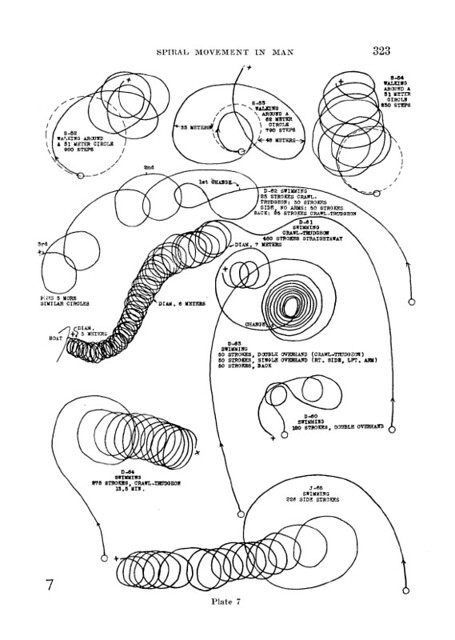
spiral movement in man

spiral movement in man -- aa shaeffer 1928


 aa shaeffer 1928

Blindfolded persons walk, run, swim, row, and drive automobiles in clock-spring spiral paths of greater or less regularity when attempting a straightaway. The spirals turn either right or left in one and the same individual, and may do so even in one experiment. But either right or left turns predominate in the great majority of individuals, often to a high degree. The paths show marked individuality, and there is some ground for thinking there exists a correlation between temperamental differences and general character of path.


The mechanism which produces the spiral path is not located in the locomotor organs, but in the central nervous system and is probably identical essentially with the spiral mechanism in other motile organisms, all of which move in spiral paths when there are no guiding senses to direct the path. The clock-spring spiral in man is interpreted as the expression in two dimensions of space of a helical spiral mechanism which seems to exist in all motile organisms moving in three dimensions of space and in amebas which move in two dimensions. In a large number of lower organisms the number of body lengths per spiral turn is almost constant, being about 4.5. The smallest regular swimming spirals in man are very close to this value, but the smallest regular walking spirals are somewhat larger. The fundamental spiral mechanism seems to be of molecular dimensions, and there seems to exist a demonstrable locomotor bilateral asymmetry in very nearly, if not quite, all organisms.

(via https://www.flickr.com/photos/pluriverse/)

woensdag 28 januari 2015

line and polysemy

Polysemy

Polysemy (/pəˈlɪsɨmi/ or /ˈpɒlɨsmi/;[1][2] from Greek: πολυ-, poly-, "many" and σῆμα, sêma, "sign") is the capacity for a sign (e.g., a word, phrase, etc.) or signs to have multiple related meanings (sememes), i.e., a large semantic field

 http://en.wikipedia.org/wiki/Polysemy


Line
"The following list provides brief descriptions of the 25 senses of line in WordNet:

1. wrinkle, furrow, crease, crinkle, seam, line: "His face has many wrinkles"
2. line: a length (straight or curved) without breadth or thickness
3. line, dividing line: "there is a narrow line between sanity and insanity"
4. agate line, line: space for one line of print used to measure advertising
5. credit line, line of credit, line: the maximum credit that a customer is allowed
6. line: in games or sports; a mark indicating positions or bounds of the playing area
7. line: a spatial location defined by a real or imaginary unidimensional extent
8. course, line: a connected series of events or actions or developments
9. line: a formation of people or things one after (or beside) another
10. lineage, line, line of descent, descent, bloodline, blood line, blood, pedigree
I 1. tune, melody, air, strain, melodic fine, line, melodic phrase: a succession of notes
12. line: a linear string of words expressing some idea
13. line: a mark that is long relative to its width; "He drew a line on the chart"
14. note, short letter, line: "drop me a line when you get there"
15. argumentation, logical argument, line of thought, line of reasoning, line
16. telephone line, phone line, line: a telephone connection
17. production line, assembly line, line: a factory system
18. pipeline, line: a long pipe used to transport liquids or gases
19. line: a commercial organization serving as a common carrier
20. line, railway line, rail line: railroad track and roadbed
21. line: something long and thin and flexible
22. cable, line, transmission line: electrical conductor connecting telephones or television
23. line, product line, line of products, line of merchandise, business line, line of business
24. line: acting in conformity; "in line with" or "he got out of line" or "toe the line"
25. occupation, business, line of work, line: the principal activity in your life"


from;
Disambiguating Noun Groupings with Respect to WordNet Senses
Philip Resnik 
 http://www.aclweb.org/anthology/W95-0105

from;Ingold, Tim.  the life of lines. routledge 2015


maandag 8 september 2014

Digital Muscle Control Drawings (Visual Art by Computer-Controlled Human Gestures)

from the Institute of Artificial Art Amsterdam

http://iaaa.nl/MuscleControl/index.html
This project involves a collaboration between the Department of Visual Art and the Department of ArtiFacial Expression. It produces automatic drawings by means of computer-controlled human gestures. The techniques developed for the project ArtiFacial Expression are used here to control the movements of the hands of a human person who has a piece of paper in one hand and a drawing pen in the other.
  
          First public demonstration
Art Academy, 's Hertogenbosch. Studium Generale, Change Your Mind. April 12, 1995.


dinsdag 14 mei 2013

The Life and Opinions of Tristram Shandy, Gentleman

"I am now beginning to get fairly into my work; and by the help of a vegetable diet, with a few of the cold seeds, I make no doubt but I shall be able to go on with my uncle Toby’s story, and my own, in a tolerable strait line. Now,


These were the four lines I moved in through my first, second, third, and fourth volumes.—In the fifth volume I have been very good,——the precise line I have described in it being this:


By which it appears, that except at the curve, marked A, where 348 I took a trip to Navarre,—and the indented curve B, which is the short airing when I was there with the Lady Baussiere and her page,—I have not taken the least frisk of a digression, till John de la Casse’s devils led me the round you see marked D.—for as for c c c c c they are nothing but parentheses, and the common ins and outs incident to the lives of the greatest ministers of state; and when compared with what men have done,—or with my own transgressions at the letters A B D—they vanish into nothing.
In this last volume I have done better still—for from the end of Le Fever’s episode, to the beginning of my uncle Toby’s campaigns,—I have scarce stepped a yard out of my way.
If I mend at this rate, it is not impossible——by the good leave of his grace of Benevento’s devils——but I may arrive hereafter at the excellency of going on even thus:
which is a line drawn as straight as I could draw it, by a writing-master’s ruler (borrowed for that purpose), turning neither to the right hand or to the left.
This right line,—the path-way for Christians to walk in! say divines——
——The emblem of moral rectitude! says Cicero——
——The best line! say cabbage planters——is the shortest line, says Archimedes, which can be drawn from one given point to another.——
I wish your ladyships would lay this matter to heart, in your next birth-day suits!
——What a journey!
Pray can you tell me,—that is, without anger, before I write my chapter upon straight lines——by what mistake——who told them so——or how it has come to pass, that your men of wit and genius have all along confounded this line, with the line of GRAVITATION?"

http://www.gutenberg.org/files/39270/39270-h/39270-h.htm